
For a US queen bed — a 60 × 80 in / 152.4 × 203.2 cm mattress — hang art 36-45 in (91-114 cm) wide, which is 60-75% of the mattress width, as a single piece or as the combined width of a small group. Hang the top edge 6-12 in (15-30 cm) above the headboard, or centre the art 24-30 in (61-76 cm) above the mattress top if there’s no headboard. This guide shows the arithmetic behind those ranges, a worked example using one of the shop’s own AI-generated canvas prints, and exactly where the 60-75% rule stops applying.
How wide should the art be?
The 60-75% rule comes from the same visual-balance convention decor writers use for sofas and dressers: a piece of art (or the total width of a small arrangement) should span roughly two-thirds to three-quarters of the furniture it hangs above. It’s a convention, not a physical law, but multiple independent decor sources converge on the same range, which is why it’s worth treating as a reliable starting point rather than a hard rule. For a US queen mattress at 152.4 cm (60 in) wide: 152.4 × 0.60 = 91.44 cm and 152.4 × 0.75 = 114.3 cm, giving a target width of 91.4-114.3 cm, or 36-45 in in US sizing.
Continental Europe doesn’t have one fixed “queen” size the way the US market does. Common double-bed widths there run 140, 160 or 180 cm, all typically 200 cm long. If you’re outside the US, measure your own headboard or mattress width and run it through the same formula rather than assuming the 152.4 cm figure above — a 160 cm headboard needs roughly 160 × 0.60 = 96 cm to 160 × 0.75 = 120 cm of art, not 91-114 cm. For the general inch-to-cm reference (1 in = 2.54 cm exactly) used throughout this guide, see the poster sizes guide.
How high should it hang?
Hang the top edge of the art 6-12 in (15.2-30.5 cm) above the top of the headboard. Use the lower end of that range — closer to 15 cm — for a low or standard headboard, so the art doesn’t float too far away from it, and the higher end, nearer 30 cm, for a tall or upholstered headboard that already fills more of the wall. If there’s no headboard at all, centre the art 24-30 in (61-76 cm) above the top of the mattress instead, measuring to the vertical centre of the piece rather than to its top edge.
This is not the same as the general gallery “eye-level” rule, which centres art at 57-60 in (145-153 cm) from the floor. That convention is for open wall space where someone is usually standing in front of the piece — a hallway, a living room wall, a stairwell. Above a bed, nobody is standing at eye level in front of the art; the headboard (or the mattress top, if there’s no headboard) is the fixed visual reference point you’re building from instead, so the eye-level number simply doesn’t apply here.
Worked example: one statement canvas print
Peaceful Beach Landscape: Serene Coastal Canvas Print — AI-directed by Burak Basci and AI-generated for this shop — is available at 36 × 24 in (91.44 × 60.96 cm), among other sizes. Checking it against the formula above: 91.44 ÷ 152.4 = 60.0% of a queen mattress’s width — right at the lower edge of the 60-75% range. That makes it a solid anchor example for a single statement piece above a queen headboard.
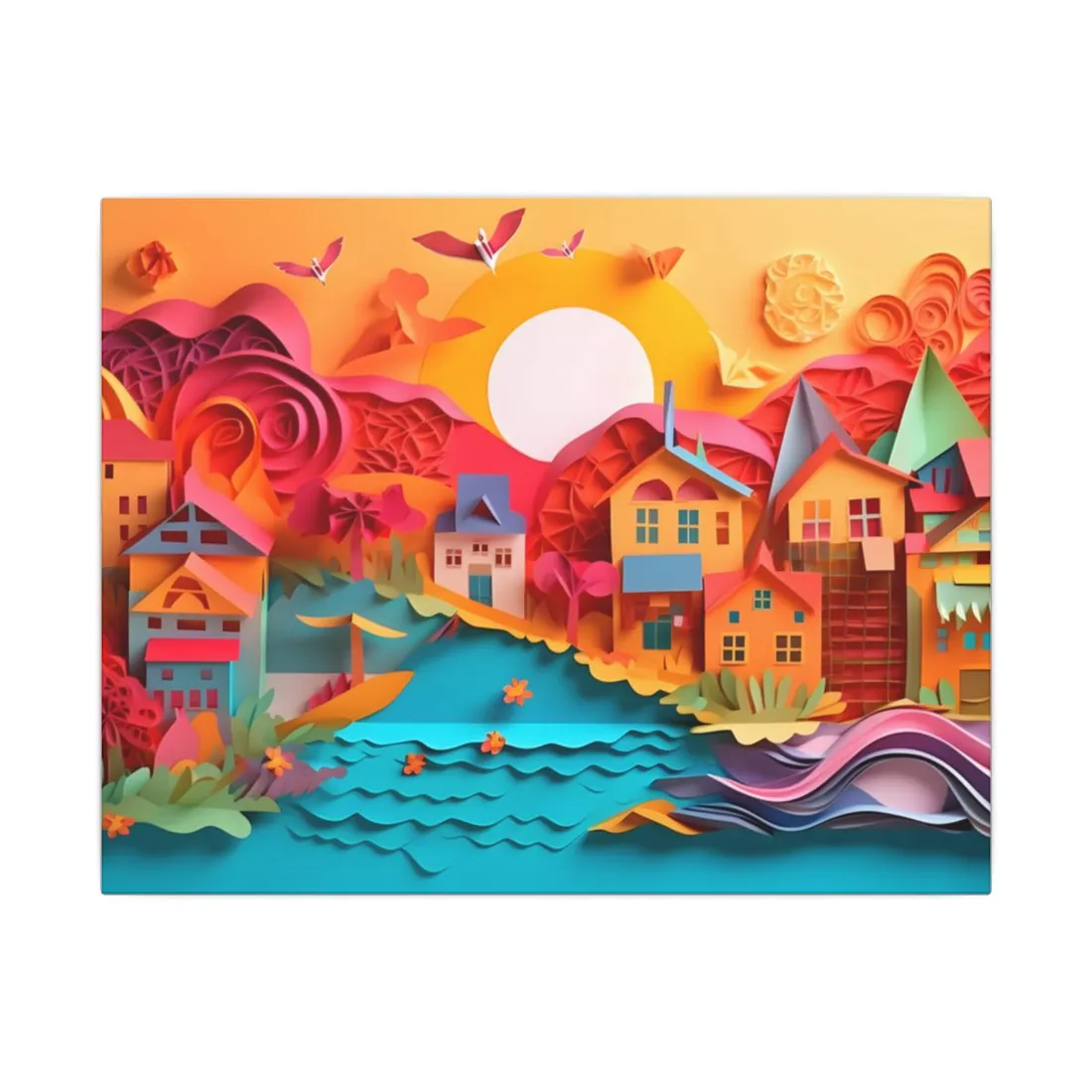
The same product is also available at 30 × 20 in (76.2 × 50.8 cm). Run the same check: 76.2 ÷ 152.4 = 50% — below the 60% floor. On its own, centred above a full queen headboard, that size will look undersized; it’s better suited to a narrower wall, above a dresser, or a nightstand-width spot next to the bed rather than spanning the headboard alone. This is exactly where the 60-75% rule stops applying: it describes proportion to the furniture below, and a piece that’s too narrow for that furniture breaks the proportion even though nothing else about it is wrong.
The same single-canvas approach doesn’t carry over to a king bed. A king mattress is 76 × 80 in (193 × 203.2 cm) — 16 in (41 cm) wider than a queen. The 36 × 24 in canvas above works out to 91.44 ÷ 193 = 47.4% of a king’s width, under the 60% floor. A king headboard needs either a noticeably wider single piece or a pair of canvases side by side, not the same size used for a queen.
A small multi-piece arrangement instead
If one large piece doesn’t suit the wall or the budget, the same measuring method from the shop’s small gallery-wall guide applies directly above a bed: measure the actual paper size of each piece, add real gaps between them, and centre the total combined width above the headboard the same way you’d centre a single canvas on any wall. The only thing that changes above a bed is which edge you measure up from — the headboard or mattress top, as described above, rather than an arbitrary point on an open wall. That guide walks through the paper-template method in detail; the 60-75% target width above still applies to the combined outer width of the group, not to each piece individually, so three narrower prints with real gaps between them can hit the same 91.4-114.3 cm target as one large canvas.
Framed posters above a bed
Artistic Female Portrait: Elegant Dress Framed Poster is used here purely as a size example, not as a bedroom recommendation — it’s a portrait piece, and nothing here claims it suits this particular wall. Its largest available size is 20 × 28 in (50.8 × 71.12 cm). Checked against the same formula: 50.8 ÷ 152.4 = 33.3% of a queen’s width, well under the 60% floor, so a single framed poster this size suits a narrower wall, a dresser top, or the space beside the bed rather than spanning the headboard alone.
There’s also a physical reason to think twice about framed, glazed pieces directly above where someone sleeps: avoid hanging glass-fronted or metal-edged art directly over a bed. A bed is somewhere a person lies still for hours, directly underneath whatever hangs on the wall above, which makes that spot a poor place for anything with glass or a rigid metal edge. Gallery-wrapped canvas (no glass) or an unframed poster are the safer picks for that exact spot. That maps onto this shop’s own catalogue in a useful way: canvas prints have no glass and posters ship unframed, while framed posters do have glass or acrylic glazing and are better suited to a wall away from the bed — a hallway, an office, or beside rather than directly above the headboard.
| Piece | Width | % of queen width (152.4 cm) | Works alone above a queen headboard? |
|---|---|---|---|
| 36 × 24 in canvas | 91.44 cm | 60.0% | Yes — anchor example |
| 30 × 20 in canvas | 76.2 cm | 50.0% | No — under the 60% floor |
| 20 × 28 in framed poster | 50.8 cm | 33.3% | No — well under the floor |
Frequently asked questions
What size art should I hang above a queen bed?
Aim for 36-45 in (91-114 cm) wide — 60-75% of a 60 in / 152.4 cm queen mattress’s width — as a single piece or as the combined width of a small group. That’s a visual-balance convention used for furniture generally, not a physical law, so treat it as a strong starting range rather than an exact number.
How high above a queen headboard should art hang?
6-12 in (15-30 cm) above the top of the headboard — use the lower end for a low or standard headboard and the higher end for a tall or upholstered one. If there’s no headboard, centre the art 24-30 in (61-76 cm) above the mattress top instead, measuring to the centre of the piece rather than its top edge.
Does the usual eye-level picture-hanging rule apply above a bed?
No. That convention — centring art at 57-60 in (145-153 cm) from the floor — is for open wall space viewed standing up. Above a bed, measure up from the headboard or mattress top instead, not from the floor.
Is it safe to hang framed art with glass directly over a bed?
It’s safer to avoid it. Gallery-wrapped canvas (no glass) or unframed paper are the better choice directly above a sleeping area; framed, glazed pieces suit a nearby wall instead.
Does the same sizing work for a king bed?
No. A king mattress is 16 in (41 cm) wider than a queen (76 × 80 in / 193 × 203.2 cm), so a 36 × 24 in canvas sized for a queen only reaches about 47% of a king’s width — under the 60% floor — and will usually read as too narrow above it. Use a wider single piece or a pair of canvases side by side instead.
Browse the rest of the shop’s AI-assisted buying guides, including print sizes and small gallery-wall layouts, in the guides hub.
An AI-assisted buying guide from Burak Basci Shop. Featured artworks are AI-generated; check each product page for current sizes and finishes.